More players
Chaturaji
India’s four-handed chess: kings can be captured, captures score.
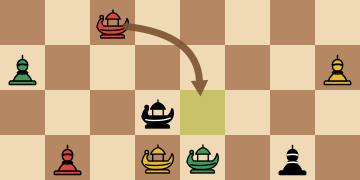 Play in your browser
The game runs in your browser and needs JavaScript.
What you can do here
- Bots from Novice to Club player, or friends at the same device
- A short course on the rules, task by task on the board
- The boats’ triumph and the old promotion rules, explained on the board
Rules: Free for all
Four armies on an ordinary board, everyone for themselves. There is no check: kings are captured like any piece, and points decide the places.
Board and turns
Each army starts in a corner of the 8 by 8 board: boat, horse, elephant and king along its edge, four pawns in front. Red moves first, then Green, Yellow and Black, clockwise. A player who has no move passes.
Pieces
The king steps one square in any direction. The elephant moves like a rook, any distance straight. The horse jumps like a knight. The boat jumps exactly two squares diagonally, over whatever stands between. The pawn steps one square forward and captures one square diagonally forward; it has no double step.
No check
Nothing forces a king out of an attack, and a king may step onto an attacked square. Whoever captures a live king takes that player out: their pieces turn grey and stay on the board as obstacles that anyone may capture for nothing.
Promotion
On its far edge a pawn becomes a boat in the corners, a horse on the squares next to them and an elephant on the next ones. It may step there only once its army has lost such a piece, and never onto the two middle squares: a pawn never becomes a king.
The boats’ triumph
A boat that completes a square of four boats, 2 by 2, one of each army, captures the other three at once.
Points
Capturing a pawn scores 1, a boat 2, a horse 3, an elephant 4 and a king 5. A promoted pawn is worth its new piece. Grey pieces score nothing.
The end
A player who captures all three other kings and keeps their own wins outright, with at least 54 points: that is chaturaji, “four kings”. Otherwise the game ends when one player is left, when the players still in have nothing but their kings, when the places can no longer change, after the same position three times, or after fifty moves of every player without a capture or a pawn move. Points decide the places. A player may resign: their army turns grey, the king too.
Dice (if chosen)
With dice, as al-Biruni describes the game, each turn throws two dice: 1 or 5 moves a pawn or the king, 2 the boat, 3 the horse, 4 or 6 the elephant. Each die is one move of such a piece, in either order, and one piece may make both. A die with no such move is lost, a player may skip the rest of the turn, and a captured king ends it.
History
Chaturaji is the oldest game of the chess family for four. The scholar al-Biruni described it around 1030 in his book on India: two dice named the piece to move, and the winner was paid by the value of the pieces taken, 54 for all three kings with one’s own still on the board. The fullest rules are verses in Raghunandana’s Tithitattva, written in Bengal around 1500, with the boats’ triumph and other special wins. Sir William Jones published them in 1790 and called the game chaturaji, “four kings”; Hiram Cox and Duncan Forbes took it for the ancestor of chess, which H. J. R. Murray rejected in 1913. In the 19th century it was still played in India without dice, by two pairs of partners sitting opposite. The elephant moves like a rook and the boat leaps like Shatranj’s alfil, as both old sources describe them; the old rules of promotion are unclear, so this game follows Murray’s reading.
Rules: Teams
Four armies on an ordinary board, two against two: Red and Yellow against Green and Black. There is no check: kings are captured like any piece.
Board and turns
Each army starts in a corner of the 8 by 8 board: boat, horse, elephant and king along its edge, four pawns in front. Red moves first, then Green, Yellow and Black, clockwise. A player who has no move passes. Your partner sits opposite.
Pieces
The king steps one square in any direction. The elephant moves like a rook, any distance straight. The horse jumps like a knight. The boat jumps exactly two squares diagonally, over whatever stands between. The pawn steps one square forward and captures one square diagonally forward; it has no double step.
No check
Nothing forces a king out of an attack. A player whose king is captured is out: their pieces turn grey and stay as obstacles, and their partner plays on. Partners never capture each other’s pieces.
Promotion
On its far edge a pawn becomes a boat in the corners, a horse on the squares next to them and an elephant on the next ones. It may step there only once its army has lost such a piece, and never onto the two middle squares: a pawn never becomes a king.
The boats’ triumph
A boat that completes a square of four boats, 2 by 2, one of each army, captures the opponents’ boats at once.
The end
The team that captures both opposing kings wins, or the team that leaves its opponents nothing but their kings. Kings only on both sides, the same position three times, and fifty moves of every player without a capture or a pawn move are draws.
Dice (if chosen)
With dice, as al-Biruni describes the game, each turn throws two dice: 1 or 5 moves a pawn or the king, 2 the boat, 3 the horse, 4 or 6 the elephant. Each die is one move of such a piece, in either order, and one piece may make both. A die with no such move is lost, a player may skip the rest of the turn, and a captured king ends it.
History
Chaturaji is the oldest game of the chess family for four. The scholar al-Biruni described it around 1030 in his book on India: two dice named the piece to move, and the winner was paid by the value of the pieces taken, 54 for all three kings with one’s own still on the board. The fullest rules are verses in Raghunandana’s Tithitattva, written in Bengal around 1500, with the boats’ triumph and other special wins. Sir William Jones published them in 1790 and called the game chaturaji, “four kings”; Hiram Cox and Duncan Forbes took it for the ancestor of chess, which H. J. R. Murray rejected in 1913. In the 19th century it was still played in India without dice, by two pairs of partners sitting opposite. The elephant moves like a rook and the boat leaps like Shatranj’s alfil, as both old sources describe them; the old rules of promotion are unclear, so this game follows Murray’s reading.
More games
Chess and variants
- Chess · Classic chess or Chess960 with a shuffled back rank, against a bot.
- Chess960 · Fischer random chess: the back rank starts in one of 960 setups.
- Antichess · Losing chess: give away all your pieces, captures are compulsory.
- Atomic chess · Every capture is an explosion that clears the pieces around it.
- Crazyhouse · Captured pieces change sides and can be dropped back onto the board.
- Duck chess · After every move you move the duck, which blocks everyone. No check.
- Fog of War · You only see where your pieces can move. Capture the king to win.
- Friendly Chess · Nothing is captured: pieces unite and set off chain reactions.
The chess family
- Chaturanga · India’s ancient chess, the root of the family: take the king to win.
- Shatranj · The medieval ancestor of chess, with a weak ferz and a jumping alfil.
- Makruk · Thai chess: a slow, strategic game with a counting rule.
- Ouk Chatrang · Cambodian chess: Makruk with a leap for the king and the met.
- Sittuyin · Burmese chess: set up your pieces, then promote on the diagonals.
- Xiangqi · Chinese chess: a river, palaces and a cannon that jumps to capture.
- Janggi · Korean chess: no river, palace diagonals and a cannon that always jumps.
- Shogi · Japanese chess: captured pieces return to the board on your side.
- Minishogi · Shogi on a 5 × 5 board: six pieces a side, short and sharp games.
More players
- Four Seasons Chess · Alfonso X’s chess for four from 1283: four seasons, the last king wins.
- Three-player chess · Three armies on a hexagonal board: you against two bots.
- Four-player chess · Four armies on a cross-shaped board: in teams or all against all.
- Eight-player chess · Eight armies on a board of 516 squares: all against all, in pairs or four against four.