The chess family
Xiangqi
Chinese chess: a river, palaces and a cannon that jumps to capture.
 Play in your browser
The game runs in your browser and needs JavaScript.
What you can do here
- Bots from Novice to Club player, or friends at the same device
- A short course on the rules and the classic techniques, task by task on the board
- Over 2,800 puzzles that adapt to your level
- Characters or symbols on the pieces, algebraic or WXF notation
How Xiangqi is played
Xiangqi is Chinese chess, the most popular board game in China, also played in Vietnam as cờ tướng. The pieces stand on the points where the lines cross, not in squares. The goal is to checkmate the opposing general: to attack it so that no move can save it. An attacked general is in check, and no move may leave your own general attacked.
The board
The board has nine files and ten ranks of points. The river across the middle divides the two halves, and each side has a palace of nine points with two diagonals. Red moves first.
The pieces
The chariot moves any number of points along a line, forward, back or sideways, but not over other pieces. The horse steps one point straight and then one diagonally outward; a piece on that first point blocks it. The elephant moves exactly two points diagonally, cannot pass a piece on the point between and never crosses the river. A piece captures by moving onto an enemy piece.
The cannon
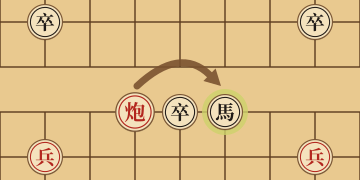
The cannon moves like the chariot, but it captures only by jumping over exactly one piece, of either side, onto an enemy piece behind it.
Generals and palace
The general steps one point along a line, the advisors one point diagonally, and neither leaves the palace. The two generals may never face each other on a file with nothing between them.
Soldiers
A soldier steps one point forward. Once it has crossed the river, it may also step one point sideways. It never moves back and does not promote.
Winning and draws
Checkmate wins, and a side that has no legal move loses too, even when it is not in check. Fifty moves without a capture are a draw, and so is a position where neither side has a piece left that can attack.
Repetition
When a position occurs for the third time, the side that gave check with every move of the repetition loses. Otherwise the side that kept chasing a piece loses: an unprotected one, or a stronger one such as a chariot attacked by a horse. If neither side did, or both did, the game is drawn. These are the rules of the Asian Xiangqi Federation as Fairy-Stockfish and pychess play them.
Where it comes from
Most historians trace xiangqi, like chess, to the Indian chaturanga; some see a Chinese origin. The earliest description of its rules dates from the Tang dynasty. The river is called “Chu river, Han border” after the war between Chu and Han (206–202 BC). Korea’s janggi grew out of it.
Handicaps
In China the stronger player may give a horse, both horses, a cannon or a chariot (让子), as agreed before the game; here the giver plays Red, loses the piece on its left and moves first. Folk rules often protect some of the giver’s pieces too (an unmoved central soldier after horse odds, for example); this game leaves them out. The bot can give them, or you can (the setup’s "Handicap").
More games
Chess and variants
- Chess · Classic chess or Chess960 with a shuffled back rank, against a bot.
- Chess960 · Fischer random chess: the back rank starts in one of 960 setups.
- Antichess · Losing chess: give away all your pieces, captures are compulsory.
- Atomic chess · Every capture is an explosion that clears the pieces around it.
- Crazyhouse · Captured pieces change sides and can be dropped back onto the board.
- Duck chess · After every move you move the duck, which blocks everyone. No check.
- Fog of War · You only see where your pieces can move. Capture the king to win.
- Friendly Chess · Nothing is captured: pieces unite and set off chain reactions.
The chess family
- Chaturanga · India’s ancient chess, the root of the family: take the king to win.
- Shatranj · The medieval ancestor of chess, with a weak ferz and a jumping alfil.
- Makruk · Thai chess: a slow, strategic game with a counting rule.
- Ouk Chatrang · Cambodian chess: Makruk with a leap for the king and the met.
- Sittuyin · Burmese chess: set up your pieces, then promote on the diagonals.
- Janggi · Korean chess: no river, palace diagonals and a cannon that always jumps.
- Shogi · Japanese chess: captured pieces return to the board on your side.
- Minishogi · Shogi on a 5 × 5 board: six pieces a side, short and sharp games.
More players
- Chaturaji · India’s four-handed chess: kings can be captured, captures score.
- Four Seasons Chess · Alfonso X’s chess for four from 1283: four seasons, the last king wins.
- Three-player chess · Three armies on a hexagonal board: you against two bots.
- Four-player chess · Four armies on a cross-shaped board: in teams or all against all.
- Eight-player chess · Eight armies on a board of 516 squares: all against all, in pairs or four against four.