More players
Four Seasons Chess
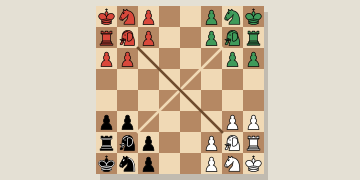
Alfonso X’s chess for four from 1283: four seasons, the last king wins.
 Play in your browser
The game runs in your browser and needs JavaScript.
What you can do here
- Bots from Novice to Intermediate, or friends at the same device
- A short course on the rules, task by task on the board
- Each pawn’s way marked on the board, the old coins counted for you
How Four Seasons Chess works
Four armies in the corners of an ordinary board, everyone for themselves. Mate a king and its army becomes yours; the last king left wins.
Board and turns
Each army starts in a corner: the king in the corner, the rook and the knight beside it, the alfil in front, and two pawns along each of its two edges. Green (spring) moves first, then Red (summer), Black (autumn) and White (winter), as the seasons follow each other. The two lines across the middle only show where the pawns go.
Pieces
The king steps one square in any direction, the rook moves any distance straight and the knight jumps as in chess. The alfil jumps exactly two squares diagonally, over whatever stands between. Every pawn keeps the direction it starts with: it steps one square along its edge towards a neighbouring army, never two, and captures one square diagonally forward. On the far edge it becomes a ferz, which steps one square diagonally.
Check and mate
As in chess, no move may leave your own king attacked by any of the three others. A player is mated, or stalemated, only when their turn comes; the mate counts for the player who attacked the king last. A king left in reach, for instance after a discovered attack by a third player, may simply be taken: that counts as a mate.
The army of a mated player
A mated player is out. Their king leaves the board and the rest of the army changes colour: it belongs to the player who gave the mate, who moves it from then on. A stalemated player is out too, and their pieces leave the board, as do the pieces of a player who resigns.
The end
The last king left wins; the others are placed by the order they went out. The game is drawn among the players still in after the same position three times, after fifty rounds without a capture or a pawn move, or when only kings are left.
Coins
The game was played for money, and the coins keep the old count without deciding the places. A lost piece pays its taker one coin, a check pays the checker one. A mated player pays the mater a coin for every piece they had. The second player out puts their winnings and a coin per piece into the pot; the last one pays the winner a coin per piece, and the winner takes the pot.
The die (if chosen)
With the die, each turn throws one: 6 moves the king, 5 a ferz, 4 the rook, 3 the knight, 2 the alfil and 1 a pawn. If no such piece can move, the turn is lost. A player in check whose throw cannot answer it loses the turn too, and their king may then be taken. Mate and stalemate do not depend on the throw.
History
King Alfonso X of Castile had the Book of Games written in his scriptorium; it was finished in 1283. Besides chess, dice and tables it describes this chess of the four seasons (acedrex de los quatro tiempos): green spring, red summer, black autumn and white winter, like the four elements and the four humours of the body. Each player was to attack the one to the right and guard against the one to the left, and the game was played for coins: for every piece lost, every check and every mate. The book adds a game of tables for four, “the world”, played with the dice of this chess. The text leaves much open. H. J. R. Murray read it in 1913, and most descriptions since follow him, as this game does: the mater takes over the mated army, where the text itself has its pieces leave the board. In Alfonso’s ordinary chess the ferz could leap on its first move, but no description of this game gives it that leap.
More games
Chess and variants
- Chess · Classic chess or Chess960 with a shuffled back rank, against a bot.
- Chess960 · Fischer random chess: the back rank starts in one of 960 setups.
- Antichess · Losing chess: give away all your pieces, captures are compulsory.
- Atomic chess · Every capture is an explosion that clears the pieces around it.
- Crazyhouse · Captured pieces change sides and can be dropped back onto the board.
- Duck chess · After every move you move the duck, which blocks everyone. No check.
- Fog of War · You only see where your pieces can move. Capture the king to win.
- Friendly Chess · Nothing is captured: pieces unite and set off chain reactions.
The chess family
- Chaturanga · India’s ancient chess, the root of the family: take the king to win.
- Shatranj · The medieval ancestor of chess, with a weak ferz and a jumping alfil.
- Makruk · Thai chess: a slow, strategic game with a counting rule.
- Ouk Chatrang · Cambodian chess: Makruk with a leap for the king and the met.
- Sittuyin · Burmese chess: set up your pieces, then promote on the diagonals.
- Xiangqi · Chinese chess: a river, palaces and a cannon that jumps to capture.
- Janggi · Korean chess: no river, palace diagonals and a cannon that always jumps.
- Shogi · Japanese chess: captured pieces return to the board on your side.
- Minishogi · Shogi on a 5 × 5 board: six pieces a side, short and sharp games.
More players
- Chaturaji · India’s four-handed chess: kings can be captured, captures score.
- Three-player chess · Three armies on a hexagonal board: you against two bots.
- Four-player chess · Four armies on a cross-shaped board: in teams or all against all.
- Eight-player chess · Eight armies on a board of 516 squares: all against all, in pairs or four against four.