The chess family
Medieval chess
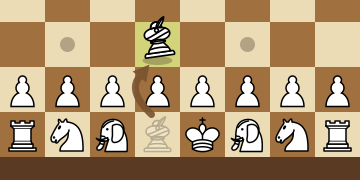
Europe’s chess before 1475: the fers and the king may leap on their first move.
 Play in your browser
The game runs in your browser and needs JavaScript.
What you can do here
- Bots from Novice to Club player, or friends at the same device
- A short course on the rules, task by task on the board
- Over 1,100 puzzles that adapt to your level
- The rules most medieval sources agree on, each region’s differences in the history
How medieval chess is played
Medieval chess is the game Europe played from about the year 1000 until the queen and the bishop got their modern moves around 1475: Shatranj on a chequered board, with three new first moves. The goal is to checkmate the opposing king: to attack it so that no move can save it. An attacked king is in check, and no move may leave your own king attacked.
The pieces
The pieces stand as in chess today, the ferz (the medieval queen) beside the king on its own colour. The king steps one square in any direction, the rook moves along ranks and files, and the knight jumps in an L. The ferz steps one square diagonally. The alfil, in the bishop’s place, jumps exactly two squares diagonally, over whatever stands between. There is no castling.
The leaps
On its first move the ferz may leap two squares straight or diagonally, over a piece, onto an empty square; a ferz new from a promotion may do the same on its first move. Once in a game, on its first move, the king may leap to an empty square two away: from e1 to c1, c2, c3, d3, e3, f3, g3, g2 or g1. It may not leap while in check, into check or across a square the opponent attacks (the square in between; a leap shaped like the knight’s crosses none). A leap never captures, so it never gives check.
Pawns
A pawn moves one square forward and captures one square diagonally forward. From its starting square it may move two squares, but only until the first capture of the game; there is no en passant. A pawn that reaches the last rank always becomes a ferz, however many ferzes are on the board.
Winning
Checkmate wins. Stalemate, a player who cannot move but is not in check, is a draw. You also win by capturing every piece of your opponent except the king, a bare king; if the bare king can capture your last piece right away, the game is drawn instead.
Draws
The same position three times, or seventy moves each without a capture or a pawn move, is a draw. The old sources know no such rule; it is ours, so that a lost game cannot drag on forever.
Where it comes from
Chess reached Christian Europe around the year 1000 through Muslim Spain and through Italy. Europe put the ferz beside the king and coloured the board’s squares, then added the ferz’s leap, the pawn’s double step and, around 1300, the king’s leap, the ancestor of castling. Every region had its own rules: Alfonso X’s book of 1283 has no king’s leap, Lombardy let the king leap farther, Spain counted stalemate as half a win. This game follows what most sources give. Around 1475 in Valencia the ferz became the queen and the alfil the bishop with their modern moves, and Lucena’s book of 1497 already teaches the new game. The old names: Latin regina or ferzia, Old French fierce, English fers for the ferz; aufin or alfil for the alfil.
More games
Chess and variants
- Chess · Classic chess or Chess960 with a shuffled back rank, against a bot.
- Chess960 · Fischer random chess: the back rank starts in one of 960 setups.
- Antichess · Losing chess: give away all your pieces, captures are compulsory.
- Atomic chess · Every capture is an explosion that clears the pieces around it.
- Crazyhouse · Captured pieces change sides and can be dropped back onto the board.
- Duck chess · After every move you move the duck, which blocks everyone. No check.
- Fog of War · You only see where your pieces can move. Capture the king to win.
- Friendly Chess · Nothing is captured: pieces unite and set off chain reactions.
The chess family
- Chaturanga · India’s ancient chess, the root of the family: take the king to win.
- Shatranj · The medieval ancestor of chess, with a weak ferz and a jumping alfil.
- Makruk · Thai chess: a slow, strategic game with a counting rule.
- Ouk Chatrang · Cambodian chess: Makruk with a leap for the king and the met.
- Sittuyin · Burmese chess: set up your pieces, then promote on the diagonals.
- Kar Ouk · Ouk Chatrang where the first check wins: guard your king.
- Xiangqi · Chinese chess: a river, palaces and a cannon that jumps to capture.
- Janggi · Korean chess: no river, palace diagonals and a cannon that always jumps.
- Shogi · Japanese chess: captured pieces return to the board on your side.
- Minishogi · Shogi on a 5 × 5 board: six pieces a side, short and sharp games.
More players
- Chaturaji · India’s four-handed chess: kings can be captured, captures score.
- Four Seasons Chess · Alfonso X’s chess for four from 1283: four seasons, the last king wins.
- Three-player chess · Three armies on a hexagonal board: you against two bots.
- Four-player chess · Four armies on a cross-shaped board: in teams or all against all.
- Eight-player chess · Eight armies on a board of 516 squares: all against all, in pairs or four against four.