Chess and variants
Kriegspiel
Only your own pieces in sight; an umpire judges every move.
 Play in your browser
The game runs in your browser and needs JavaScript.
What you can do here
- Bots from Novice to Intermediate, or friends online or at the same device
- A short course on the rules, task by task on the board
- The English rules most sources give, “Any?” included
How Kriegspiel is played
Kriegspiel is chess in which you see only your own pieces. An umpire, who sees both armies, judges every move you try and tells both players what happened.
What you see
Your board shows only your own pieces. The opponent’s pieces stand somewhere on the empty squares; where, you work out from the umpire’s announcements. The pieces move as in ordinary chess, castling and en passant included.
Trying moves
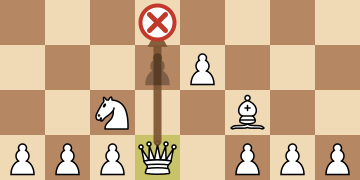
On your turn you try a move. If it is illegal in the real position, for instance because a piece you cannot see stands in the way or your king would be in check, the umpire says “No”: the piece goes back and you try another. You may try as often as you need, but not the same move twice in a turn. Both players hear every “No”.
The umpire
After a move the umpire announces that it was made, a capture by its square only (not what took or what was taken; en passant by the square of the removed pawn), and a check by its direction. Promotions and castling are not announced.
Checks
A check is announced as on the rank, on the file, on the long or the short diagonal (of the two diagonals through the checked king’s square), or by a knight; a double check by both directions.
“Any?”
Once a turn you may ask “Any?”: whether one of your pawns can capture. The umpire answers “Try” or “No”. After “Try” your next attempt must be a pawn capture; whether it succeeds or not, you are free after it.
The end
The umpire announces checkmate and stalemate. A stalemate, too little material to mate, and fifty moves of each side without a capture or a pawn move are draws. There is no draw by repetition, since nobody can see it.
The story
London, England · 1899
When and where
Kriegspiel was devised in London by the journalist Henry Michael Temple and is usually dated 1899. In 1898 members of his club, who met in a Fleet Street tavern for chess and acrostics, had asked for a war game.
How it changed
Each player sees only their own pieces. An umpire with a third board sees everything, rejects impossible moves and announces checks and captures.
Today
It is still played online, and researchers use it to study games of hidden information. This app plays the English rules most sources give: the umpire names a capture by its square only, and a player may ask “Any?”.
Did you know?
The name is the German word Kriegsspiel, war game.
Sources: Wikipedia · D. B. Pritchard, The Classified Encyclopedia of Chess Variants (2007)
More games
Chess and variants
- Chess · Classic chess or Chess960 with a shuffled back rank, against a bot.
- Chess960 · Fischer random chess: the back rank starts in one of 960 setups.
- Antichess · Losing chess: give away all your pieces, captures are compulsory.
- Atomic chess · Every capture is an explosion that clears the pieces around it.
- Crazyhouse · Captured pieces change sides and can be dropped back onto the board.
- Duck chess · After every move you move the duck, which blocks everyone. No check.
- Fog of War · You only see where your pieces can move. Capture the king to win.
- Friendly Chess · Nothing is captured: pieces unite and set off chain reactions.
The chess family
- Chaturanga · India’s ancient chess, the root of the family: take the king to win.
- Shatranj · The medieval ancestor of chess, with a weak ferz and a jumping alfil.
- Medieval chess · Europe’s chess before 1475: the ferz and the king may leap on their first move.
- Courier chess · Medieval Germany’s chess on a 12 × 8 board, with the courier, the man and the schleich.
- Makruk · Thai chess: a slow, strategic game with a counting rule.
- Ouk Chatrang · Cambodian chess: Makruk with a leap for the king and the met.
- Sittuyin · Burmese chess: set up your pieces, then promote on the diagonals.
- Kar Ouk · Ouk Chatrang where the first check wins: guard your king.
- Xiangqi · Chinese chess: a river, palaces and a cannon that jumps to capture.
- Janggi · Korean chess: no river, palace diagonals and a cannon that always jumps.
- Shogi · Japanese chess: captured pieces return to the board on your side.
- Minishogi · Shogi on a 5 × 5 board: six pieces a side, short and sharp games.
More players
- Chaturaji · India’s four-handed chess: kings can be captured, captures score.
- Four Seasons Chess · Alfonso X’s chess for four from 1283: four seasons, the last king wins.
- Three-player chess · Three armies on a hexagonal board: you against two bots.
- Four-player chess · Four armies on a cross-shaped board: in teams or all against all.
- Verney’s four-handed chess · Verney’s game of 1881: two against two, mate both enemy kings.
- Eight-player chess · Eight armies on a board of 516 squares: all against all, in pairs or four against four.