The chess family
Tamerlane chess
Timur’s great chess on an 11 × 10 board, with giraffes, camels and citadels.
 Play in your browser
The game runs in your browser and needs JavaScript.
What you can do here
- Bots from Novice to Club player, or friends online or at the same device
- A short course on the rules, task by task on the board
- Over 1,000 puzzles that adapt to your level
- Eleven kinds of pawn, each promoting to its own piece
How Tamerlane chess is played
Tamerlane chess was the great chess of Timur’s court in the 14th century: Shatranj on a board of eleven files and ten ranks, with six more kinds of piece and a pawn for each. The goal is to checkmate the opposing king: to attack it so that no move can save it. An attacked king is in check, and no move may leave your own king attacked.
The board and the start
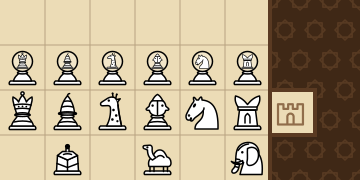
The board has eleven files, a to k, and ten ranks, all squares alike, and two citadels: one beside White’s k2, one beside Black’s a9. On White’s first rank stand the elephants (a1, k1), the camels (c1, i1) and the war engines (e1, g1); on the second the rooks, knights, scouts, giraffes, the fers on e2, the king on f2 and the vizier on g2; on the third the eleven pawns. Black stands the same way, turned round.
The pieces
The king steps one square in any direction, the rook moves along ranks and files, the knight jumps in an L. The fers steps one square diagonally, the vizier one square straight. The elephant jumps exactly two squares diagonally and the war engine exactly two straight; the camel jumps one square one way and three the other, a long knight. The scout moves diagonally like a bishop, but always at least two squares. The giraffe steps one square diagonally and then goes on straight for three squares or more; it never jumps, so every square on its way must be empty.
Pawns
A pawn moves one square forward and captures one square diagonally forward; there is no double step and no en passant. Each pawn is named after a piece and becomes that piece on the last rank: the pawn of rooks a rook, the pawn of giraffes a giraffe. The pawn of kings becomes a prince, who moves like a king.
The pawn of pawns
On the last rank the pawn of pawns stays where it is, and nobody can take it. Later its owner may put it on any square from which it attacks two enemy pieces, or one that cannot move, and whatever stood there leaves the board; then it walks on as a pawn. On the last rank again it goes to the start square of the pawn of kings (f3 or f8), and the third time it becomes an adventitious king.
The prince and the adventitious king
They move like the king. While a side has more than one of them, none is in check: they may be taken like other pieces. Only the last one left must be kept out of check.
The king’s swap
Once a game, when the king is in check or its side has no other move, it may change places with any of its own pieces, as long as it does not stand in check afterwards.
The citadels
A king that steps into the citadel in the opponent’s half draws the game (if the king is gone, the prince may do it). No other piece may enter it. A side’s own citadel is for its adventitious king alone, where nothing can take it.
Winning
Checkmate wins, and so does stalemate: a player who cannot move loses. A bare king does not lose: it can still run for the citadel.
Draws
A king in the opponent’s citadel draws. The sources know no other draw; so that every game ends, the same position three times or fifty moves each without a capture or a pawn move is a draw here too.
The story
Persia · the 14th and 15th centuries
When and where
Tamerlane chess is the great chess of the court of Timur (1336–1405), the conqueror of Central Asia and Persia. His biographer Ibn Arabshah wrote that Timur played only the great chess, on a board of ten squares by eleven, and that the small chess was a mere nothing beside it.
How it changed
It kept the pieces of Shatranj and added a vizier, two giraffes, two scouts, two camels and two war engines, and eleven pawns, each named after a piece and promoting to it. Two citadels jut out of the board: a king that reaches the one in the opponent’s half draws the game. The fullest account of its rules is a Persian manuscript kept by the Royal Asiatic Society.
Today
H. J. R. Murray (1913) thought it had been forgotten in the East since Timur’s day, and that it was better known than it deserved, thanks to Timur, that manuscript and the praise of Forbes’ History of Chess. It is played today from the manuscripts and from modern reconstructions.
Did you know?
Timur named his son Shah Rukh, his biographer says, because the news of the birth came while he was giving the check shah rukh, king and rook, in a game of chess. The best player of his court, ‘Ali ash-Shatranji, played the great chess with him.
Original piece names
shah (king) · firzan (fers) · wazir (vizier) · zurafa (giraffe) · tali‘a (scout) · faras (knight) · rukh (rook) · pil (elephant) · jamal (camel) · dabbaba (war engine) · baidaq (pawn) · shahzada (prince) · shah masnu‘a (adventitious king)
Sources: H. J. R. Murray, A History of Chess (1913) · Wikipedia · The Chess Variant Pages
More games
Chess and variants
- Chess · Classic chess, Chess960, or Los Alamos chess on 6 × 6 (1956).
- Chess960 · Fischer random chess: the back rank starts in one of 960 setups.
- Antichess · Losing chess: give away all your pieces, captures are compulsory.
- Atomic chess · Every capture is an explosion that clears the pieces around it.
- Crazyhouse · Captured pieces change sides and can be dropped back onto the board.
- Three-check · Chess where the third check wins, so every check counts.
- King of the Hill · Chess where a king that reaches the centre wins at once.
- Racing Kings · No pawns, no checks: the first king on the far rank wins.
- Horde · 36 white pawns storm a full black army.
- Dunsany’s chess · Lord Dunsany’s game of 1942: 32 pawns against a full army.
- Los Alamos chess · Chess on 6 × 6 without bishops, the first game a computer played (1956).
- Duck chess · After every move you move the duck, which blocks everyone. No check.
- Fog of War · You only see where your pieces can move. Capture the king to win.
- Kriegspiel · Only your own pieces in sight; an umpire judges every move.
- Friendly Chess · Nothing is captured: pieces unite and set off chain reactions.
The chess family
- Chaturanga · India’s ancient chess, the root of the family: take the king to win.
- Shatranj · The medieval ancestor of chess, with a weak ferz and a jumping alfil.
- Medieval chess · Europe’s chess before 1475: the ferz and the king may leap on their first move.
- Courier chess · Medieval Germany’s chess on a 12 × 8 board, with the courier, the man and the schleich.
- Makruk · Thai chess: a slow, strategic game with a counting rule.
- Ouk Chatrang · Cambodian chess: Makruk with a leap for the king and the met.
- Sittuyin · Burmese chess: set up your pieces, then promote on the diagonals.
- Kar Ouk · Ouk Chatrang where the first check wins: guard your king.
- Xiangqi · Chinese chess: a river, palaces and a cannon that jumps to capture.
- Janggi · Korean chess: no river, palace diagonals and a cannon that always jumps.
- Shogi · Japanese chess: captured pieces return to the board on your side.
- Minishogi · Shogi on a 5 × 5 board: six pieces a side, short and sharp games.
More players
- Chaturaji · India’s four-handed chess: kings can be captured, captures score.
- Four Seasons Chess · Alfonso X’s chess for four from 1283: four seasons, the last king wins.
- Three-player chess · Three armies on a hexagonal board: you against two bots.
- Four-player chess · Four armies on a cross-shaped board: in teams or all against all.
- Verney’s four-handed chess · Verney’s game of 1881: two against two, mate both enemy kings.
- Bughouse · Two boards, two teams: what you capture goes to your partner's hand.
- Eight-player chess · Eight armies on a board of 516 squares: all against all, in pairs or four against four.