Chess and variants
Hostage chess
Captured men become hostages and come back by exchange or from the airfield.
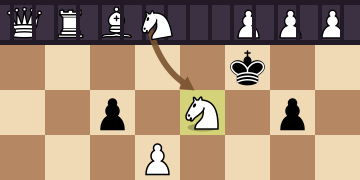 Play in your browser
The game runs in your browser and needs JavaScript.
What you can do here
- Bots from Novice to Club player, or friends online or at the same device
- A short course on the rules, task by task on the board
- Over 500 puzzles that adapt to your level
- Prisons and airfields, hostage exchanges, and a pawn that promotes only to a piece held by the opponent
How Hostage chess is played
Hostage chess is John Leslie’s game of 1997: chess in which captured men are kept as hostages and can come back, by an exchange or from the airfield.
The prison
A captured man does not leave the game: it becomes a hostage in its captor’s prison, beside the board. Both players see both prisons. A king is never captured.
Exchanging hostages
Instead of a move you may exchange hostages: hand over one of the enemy men in your prison, which goes to your opponent’s airfield, and take back one of your own men from your opponent’s prison, dropping it at once on any empty square. Your opponent cannot refuse. The man you hand over must be worth at least as much as the one you take back: a pawn, then a knight or a bishop (equal), then a rook, then a queen.
The airfield
Men your opponent has handed over wait in your airfield. Instead of a move you may drop one of them on any empty square. Any number may wait there, for as long as you like.
Dropping
A dropped man may go on any empty square, but a pawn never on the first or the last rank. A drop may give check and even mate. A pawn dropped on its second rank may still make its double step, and a rook dropped on a corner may castle while its king has not moved. A pawn just dropped cannot be taken en passant.
Promotion
A pawn promotes only by changing places with one of your own queens, rooks, bishops or knights held in your opponent’s prison: the piece comes onto the square and the pawn goes into the prison. If there are several, you choose.
The frozen pawn and the pseudo-check
With no such piece in your opponent’s prison, a pawn on its seventh rank is frozen: it cannot move onto the last rank, gives no check there and does not stop castling. A king attacked only by a frozen pawn is in pseudo-check: it may stay where it is, but its side may not take a queen, rook, bishop or knight, since that hostage would let the pawn promote and the check would become real. Pawns may be taken, and the king itself may take when its new square is safe.
Winning and draws
Checkmate wins. Stalemate, a position repeated three times and perpetual check are draws. This app also draws after fifty moves by each side without a capture, a pawn move or a pawn drop, and counts the prisons and airfields when it compares positions; these are its own choices, the inventor does not set them.
The story
Canada · John Leslie’s game of 1997
When and where
Hostage chess was invented in 1997 by John Leslie, a Canadian university teacher and the author of Universes, The End of the World and Infinite Minds. He played the first games with his friend Roger Smook.
How it changed
Leslie started from shogi, where captured men change sides, and from Chessgi (Crazyhouse), which carried that idea over to western pieces but needs a second set, and which he found too violent. In his game captured men never change sides: they come back only through an exchange that cannot be refused but costs a hostage of equal or higher value, so the balance shifts more slowly and one set is enough.
Today
Its rules went up on the Chess Variant Pages in September 1999, where it is a “Recognized” variant, and David Pritchard wrote about it the same year. Paul Connors wrote HostageMaster, a free program for Windows, and Leslie’s book Hostage Chess (2012) is free on the game’s website. It is little played: the Game Courier server shows six public games between 2004 and 2018.
Did you know?
Pritchard’s encyclopedia files Hostage chess among the games in which a captured man may be recovered by its owner, next to Chessgi. The game’s website quotes praise from grandmasters Larry Kaufman and Kevin Spraggett.
Sources: John Leslie, Hostage Chess (2012) · John Leslie, The Chess Variant Pages · John Leslie, Hostage Chess and its origins in Japanese Shogi · D. B. Pritchard, The Classified Encyclopedia of Chess Variants (2007) · Wikipedia
More games
Chess and variants
- Chess · Classic chess, or Chess960 with a shuffled back rank.
- Chess960 · Fischer random chess: the back rank starts in one of 960 setups.
- Antichess · Losing chess: give away all your pieces, captures are compulsory.
- Atomic chess · Every capture is an explosion that clears the pieces around it.
- Crazyhouse · Captured pieces change sides and can be dropped back onto the board.
- Three-check · Chess where the third check wins, so every check counts.
- King of the Hill · Chess where a king that reaches the centre wins at once.
- Jeson Mor · Mongolia’s nine horses: take the centre and hold it for a move.
- Racing Kings · No pawns, no checks: the first king on the far rank wins.
- Horde · 36 white pawns storm a full black army.
- Dunsany’s chess · Lord Dunsany’s game of 1942: 32 pawns against a full army.
- Los Alamos chess · Chess on 6 × 6 without bishops, the first game a computer played (1956).
- Duck chess · After every move you move the duck, which blocks everyone. No check.
- Marseillais chess · Two moves a turn, with one piece or two; White starts with one.
- Progressive chess · One move, then two, then three: each turn is one move longer.
- Fog of War · You only see where your pieces can move. Capture the king to win.
- Kriegspiel · Only your own pieces in sight; an umpire judges every move.
- Alice chess · Two boards: every piece that moves passes through to the other one.
- Raumschach 3D · Chess in a 5 × 5 × 5 cube: five boards stacked, and the unicorn.
- Old Raumschach · Maack’s cube as played before 1919: five pawns above the pieces.
- Friendly Chess · Nothing is captured: pieces unite and set off chain reactions.
- Ultima · Every piece captures its own way, and the immobilizer freezes.
- Gliński’s hexagonal chess · Chess on 91 hexagons: three bishops, rooks in six directions.
- McCooey’s hexagonal chess · Hexagonal chess closer to chess: seven pawns that take diagonally.
- Shafran’s hexagonal chess · Hexagonal chess on 70 cells, with castling and pawns that step three.
- Spartan chess · Persians against Spartans: chess’ army against two kings and new pieces.
- Legan chess · The armies in opposite corners; pawns step diagonally towards the far one.
Big chess
- Complete chess · The Arabic chess of the 9th century on 10 × 10, with two dabbābas a side.
- Courier chess · Medieval Germany’s chess on a 12 × 8 board, with the courier, the man and the schleich.
- Grande Acedrex · Alfonso X’s great chess on a 12 × 12 board, with lions, giraffes and a roc.
- Tamerlane chess · Timur’s great chess on an 11 × 10 board, with giraffes, camels and citadels.
- Carrera’s chess · The first chess on ten files, from a Sicilian priest’s book of 1617.
- Duke of Rutland’s chess · Fourteen files, with the concubine and two crowned rooks a side.
- Bird’s chess · Henry Bird’s ten-file chess of 1874, with the guard and the equerry.
- Capablanca chess · Ten files and two new pieces: the archbishop and the chancellor.
- Gothic chess · Ed Trice’s setup of 2000, today called Trice’s Chess.
- Capablanca Random · Capablanca chess from one of 12,118 shuffled starts.
- Embassy chess · Grand chess’ row of pieces on a 10 × 8 board.
- Janus chess · Two januses a side, each moving as a bishop or a knight.
- Grand chess · Christian Freeling’s 10 × 10 game: pawns promote only to lost pieces.
- S-chess · Chess with a hawk and an elephant in hand, placed as the back rank leaves.
The chess family
- Chaturanga · India’s ancient chess, the root of the family: take the king to win.
- Shatranj · The medieval ancestor of chess, with a weak ferz and a jumping alfil.
- Byzantine chess · Shatranj on a round board: the rook circles, pawns never promote.
- Medieval chess · Europe’s chess before 1475: the ferz and the king may leap on their first move.
- Senterej · Ethiopian chess: no turns until the first capture, then Shatranj.
- Shatar · Mongolian chess: the bers, the camel, and a mate that needs a shak.
- Makruk · Thai chess: a slow, strategic game with a counting rule.
- Ouk Chatrang · Cambodian chess: Makruk with a leap for the king and the met.
- Sittuyin · Burmese chess: set up your pieces, then promote on the diagonals.
- Kar Ouk · Ouk Chatrang where the first check wins: guard your king.
- Malay chess · Chess of the Malay world: the king leaps, a crowned pawn walks back.
- Xiangqi · Chinese chess: a river, palaces and a cannon that jumps to capture.
- Minixiangqi · Xiangqi on 7 × 7 points: no river, no advisors, no elephants.
- Manchu chess · Red’s lone chariot moves as horse and cannon too, against a full army.
- Jieqi · Xiangqi with the pieces face down: each is revealed by its first move.
- Banqi · Xiangqi’s pieces face down on half a board: turn them up, take by rank.
- Janggi · Korean chess: no river, palace diagonals and a cannon that always jumps.
- Shogi · Japanese chess: captured pieces return to the board on your side.
- Minishogi · Shogi on a 5 × 5 board: six pieces a side, short and sharp games.
- Chu shogi · Japan’s great shogi on 12 × 12: no drops, and a lion that moves twice.
- Tori shogi · Bird shogi on 7 × 7: a phoenix, quails and swallows, with drops.
More players
- Chaturaji · India’s four-handed chess: kings can be captured, captures score.
- Four Seasons Chess · Alfonso X’s chess for four from 1283: four seasons, the last king wins.
- Three-player chess · Three armies on a hexagonal board: you against two bots.
- Four-player chess · Four armies on a cross-shaped board: in teams or all against all.
- Bughouse · Two boards, two teams: what you capture goes to your partner's hand.
- Eight-player chess · Eight armies on a board of 516 squares: all against all, in pairs or four against four.
- Verney’s four-handed chess · Verney’s game of 1881: two against two, mate both enemy kings.
- Verney’s eight-handed chess · Verney’s game for eight of 1884: four against four on 448 squares.