The chess family
Jieqi
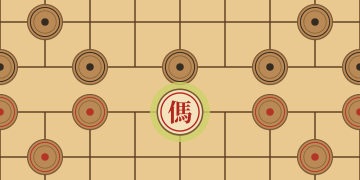
Xiangqi with the pieces face down: each is revealed by its first move.
 Play in your browser
The game runs in your browser and needs JavaScript.
What you can do here
- Bots from Novice to Club player, or friends online or at the same device
- A short course on the rules, task by task on the board
- Over 1,500 puzzles that adapt to your level
- Captured covered pieces stay secret from their owner, online too
How Jieqi is played
Jieqi is xiangqi with the pieces face down. Each side’s fifteen pieces other than the general are shuffled and set face down on its start points; a covered piece moves as the piece whose point it stands on, and that move turns it up. The goal is to checkmate the opposing general.
The start
The board is xiangqi’s. Each general stands face up on its point; the other fifteen pieces of each side are shuffled and set face down on that side’s start points: two chariots, two horses, two elephants, two advisors, two cannons and five soldiers, in any order. Red moves first.
Covered pieces
A covered piece moves as the piece of the point it stands on: on a chariot’s point as a chariot, on a horse’s point as a horse, on a soldier’s point one step forward, and so on, capturing the same way. Once it has moved it is turned up, and from then on it is what it really is, wherever it stands.
Revealed pieces
Revealed pieces move as in xiangqi, with one difference: advisors and elephants are no longer held by the palace and the river. An advisor steps one point diagonally anywhere; an elephant goes two points diagonally anywhere, still blocked by a piece on the point between. A soldier steps forward, and sideways too once across the river.
Captured covered pieces
Whoever captures a covered piece sees what it was; its owner never learns. A captured piece that was face up is seen by both.
Winning and draws
Checkmate wins, and a side with no legal move loses. Fifty moves without a capture are a draw; turning up a piece does not restart the count.
Repetition
As in xiangqi: when a position occurs for the third time, the side that checked with every move loses, otherwise the side that kept chasing a piece. A covered piece counts as the piece of its point.
Other readings
Some write that nobody sees a captured covered piece, not even the captor. Tencent’s rules forbid checking or chasing the same piece more than six turns in a row and draw after 40 rounds without a capture; a Vietnamese guide draws on a sixfold repetition. PyChess lets a covered advisor step out of the palace.
The story
Hong Kong · in the parks of Hong Kong and Guangdong from the 1980s; tournaments since 2011
When and where
Jieqi, “reveal chess”, is a folk game of Hong Kong and Guangdong. By the account most sources repeat, Lo Kam-sing and his brother brought the face-down pieces of an army game into xiangqi in the 1980s, and it spread through the parks of both. Around 2001 it grew popular in the coastal cities, under many names and with rules that differed from place to place.
How it changed
The board and the pieces are xiangqi’s, but each side’s pieces except the general start face down and shuffled; a covered piece moves as the piece of its point and is revealed by that move. Revealed advisors and elephants may leave the palace and cross the river, so the game is wilder than its parent.
Today
The first formal tournament was held in Hong Kong in 2011, written competition rules followed in 2014, with two xiangqi grandmasters as advisers, and in 2016 the Chinese Chess Association took it up. It is played on the big xiangqi apps, in Vietnam as cờ úp, and on PyChess.
Did you know?
Whoever captures a covered piece learns what it was; its owner never does, so a player can lose a chariot without knowing it.
Original piece names
the pieces of xiangqi, face down until they move: covered pieces are called “dark” (暗子), revealed ones “bright” (明子)
Sources: Wikipedia (中文), 揭棋 · 山东象棋网, 关于揭棋的发展历程 (2017) · Tencent 天天象棋, 揭棋玩法说明 (2016) · PyChess
More games
Chess and variants
- Chess · Classic chess, or Chess960 with a shuffled back rank.
- Chess960 · Fischer random chess: the back rank starts in one of 960 setups.
- Antichess · Losing chess: give away all your pieces, captures are compulsory.
- Atomic chess · Every capture is an explosion that clears the pieces around it.
- Crazyhouse · Captured pieces change sides and can be dropped back onto the board.
- Hostage chess · Captured men become hostages and come back by exchange or from the airfield.
- Three-check · Chess where the third check wins, so every check counts.
- King of the Hill · Chess where a king that reaches the centre wins at once.
- Jeson Mor · Mongolia’s nine horses: take the centre and hold it for a move.
- Racing Kings · No pawns, no checks: the first king on the far rank wins.
- Horde · 36 white pawns storm a full black army.
- Dunsany’s chess · Lord Dunsany’s game of 1942: 32 pawns against a full army.
- Los Alamos chess · Chess on 6 × 6 without bishops, the first game a computer played (1956).
- Duck chess · After every move you move the duck, which blocks everyone. No check.
- Marseillais chess · Two moves a turn, with one piece or two; White starts with one.
- Progressive chess · One move, then two, then three: each turn is one move longer.
- Fog of War · You only see where your pieces can move. Capture the king to win.
- Kriegspiel · Only your own pieces in sight; an umpire judges every move.
- Alice chess · Two boards: every piece that moves passes through to the other one.
- Raumschach 3D · Chess in a 5 × 5 × 5 cube: five boards stacked, and the unicorn.
- Old Raumschach · Maack’s cube as played before 1919: five pawns above the pieces.
- Friendly Chess · Nothing is captured: pieces unite and set off chain reactions.
- Ultima · Every piece captures its own way, and the immobilizer freezes.
- Gliński’s hexagonal chess · Chess on 91 hexagons: three bishops, rooks in six directions.
- McCooey’s hexagonal chess · Hexagonal chess closer to chess: seven pawns that take diagonally.
- Shafran’s hexagonal chess · Hexagonal chess on 70 cells, with castling and pawns that step three.
- Spartan chess · Persians against Spartans: chess’ army against two kings and new pieces.
- Legan chess · The armies in opposite corners; pawns step diagonally towards the far one.
Big chess
- Complete chess · The Arabic chess of the 9th century on 10 × 10, with two dabbābas a side.
- Courier chess · Medieval Germany’s chess on a 12 × 8 board, with the courier, the man and the schleich.
- Grande Acedrex · Alfonso X’s great chess on a 12 × 12 board, with lions, giraffes and a roc.
- Tamerlane chess · Timur’s great chess on an 11 × 10 board, with giraffes, camels and citadels.
- Carrera’s chess · The first chess on ten files, from a Sicilian priest’s book of 1617.
- Duke of Rutland’s chess · Fourteen files, with the concubine and two crowned rooks a side.
- Bird’s chess · Henry Bird’s ten-file chess of 1874, with the guard and the equerry.
- Capablanca chess · Ten files and two new pieces: the archbishop and the chancellor.
- Gothic chess · Ed Trice’s setup of 2000, today called Trice’s Chess.
- Capablanca Random · Capablanca chess from one of 12,118 shuffled starts.
- Embassy chess · Grand chess’ row of pieces on a 10 × 8 board.
- Janus chess · Two januses a side, each moving as a bishop or a knight.
- Grand chess · Christian Freeling’s 10 × 10 game: pawns promote only to lost pieces.
- S-chess · Chess with a hawk and an elephant in hand, placed as the back rank leaves.
The chess family
- Chaturanga · India’s ancient chess, the root of the family: take the king to win.
- Shatranj · The medieval ancestor of chess, with a weak ferz and a jumping alfil.
- Byzantine chess · Shatranj on a round board: the rook circles, pawns never promote.
- Medieval chess · Europe’s chess before 1475: the ferz and the king may leap on their first move.
- Senterej · Ethiopian chess: no turns until the first capture, then Shatranj.
- Shatar · Mongolian chess: the bers, the camel, and a mate that needs a shak.
- Makruk · Thai chess: a slow, strategic game with a counting rule.
- Ouk Chatrang · Cambodian chess: Makruk with a leap for the king and the met.
- Sittuyin · Burmese chess: set up your pieces, then promote on the diagonals.
- Kar Ouk · Ouk Chatrang where the first check wins: guard your king.
- Malay chess · Chess of the Malay world: the king leaps, a crowned pawn walks back.
- Xiangqi · Chinese chess: a river, palaces and a cannon that jumps to capture.
- Minixiangqi · Xiangqi on 7 × 7 points: no river, no advisors, no elephants.
- Manchu chess · Red’s lone chariot moves as horse and cannon too, against a full army.
- Banqi · Xiangqi’s pieces face down on half a board: turn them up, take by rank.
- Janggi · Korean chess: no river, palace diagonals and a cannon that always jumps.
- Shogi · Japanese chess: captured pieces return to the board on your side.
- Minishogi · Shogi on a 5 × 5 board: six pieces a side, short and sharp games.
- Chu shogi · Japan’s great shogi on 12 × 12: no drops, and a lion that moves twice.
- Tori shogi · Bird shogi on 7 × 7: a phoenix, quails and swallows, with drops.
More players
- Chaturaji · India’s four-handed chess: kings can be captured, captures score.
- Four Seasons Chess · Alfonso X’s chess for four from 1283: four seasons, the last king wins.
- Three-player chess · Three armies on a hexagonal board: you against two bots.
- Four-player chess · Four armies on a cross-shaped board: in teams or all against all.
- Bughouse · Two boards, two teams: what you capture goes to your partner's hand.
- Eight-player chess · Eight armies on a board of 516 squares: all against all, in pairs or four against four.
- Verney’s four-handed chess · Verney’s game of 1881: two against two, mate both enemy kings.
- Verney’s eight-handed chess · Verney’s game for eight of 1884: four against four on 448 squares.